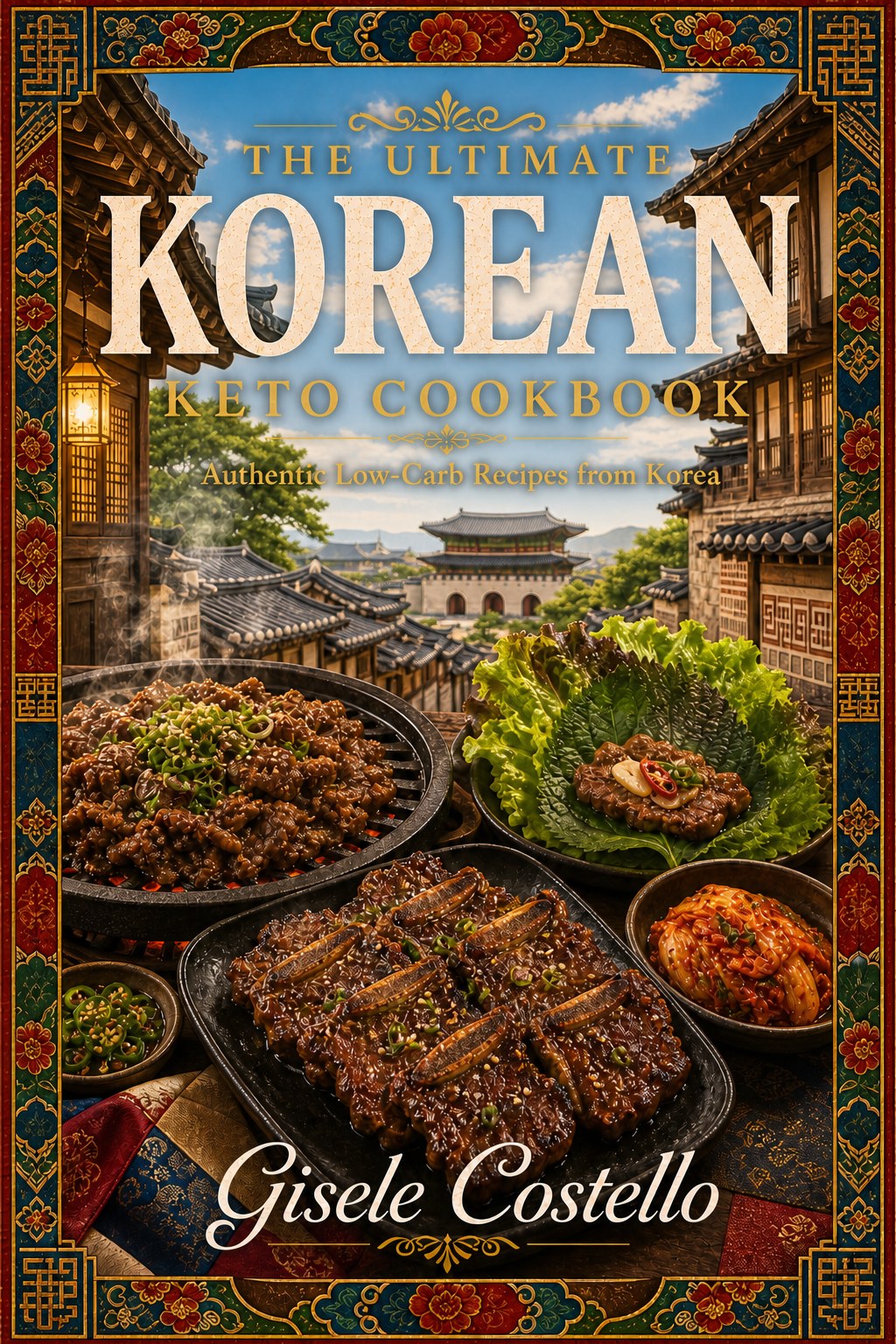
The Ultimate Korean Keto Cookbook
Table of Contents · 90 recipes in 12 chapters · by Gisele Costello
Welcome to Korea: Gyeongbokgung Palace
Gyeongbokgung, the “Palace Greatly Blessed by Heaven,” was built in 1395 by King Taejo, the founder of the Joseon dynasty, as the main royal palace of his new capital, Seoul. Behind its great gate, Gwanghwamun, the throne hall Geunjeongjeon rises above a wide stone courtyard, with the granite slopes of Bugaksan mountain behind it. The palace burned during the Japanese invasions of 1592 and lay in ruins for more than 250 years, until it was rebuilt on a grand scale in the 1860s.
Keep reading about Welcome to Korea: Gyeongbokgung Palace
During the Japanese colonial period most of its buildings were torn down, and a colonial government building was placed directly in front of the throne hall. That building was demolished in the 1990s, and restoration of the palace continues to this day. Now visitors in rented hanbok stroll its courtyards and watch the changing of the guard at the main gate. It is the perfect place to begin a journey through Korean food, a cuisine shaped by royal kitchens, farming villages, seaside markets and Buddhist temples alike.
Each chapter of this book begins at one of Korea’s great landmarks. Scroll down and travel the country one region, and one plate, at a time.
Chapter 1: Breakfast · Bukchon Hanok Village
Bukchon Hanok Village
Bukchon, whose name means “northern village,” climbs the hillside between two of Seoul’s grand Joseon-dynasty palaces, Gyeongbokgung and Changdeokgung. For centuries its lanes were home to high-ranking officials and noble families who wanted to live within walking distance of the royal court. Walk its narrow alleys early in the morning and you will see why: curved tile roofs step down the hill in neat rows, wooden gates open onto tiny courtyards, and the city’s towers rise in the distance like a different world.
Keep reading about Bukchon Hanok Village
Most of the hanok standing today were built in the 1920s and 1930s, when Seoul’s population was booming under Japanese colonial rule. A Korean developer named Chŏng Segwŏn bought up land and built traditional-style homes, fitted with glass windows and electricity, so Korean families could stay in the neighborhood rather than be pushed out. Bukchon became a hanok preservation zone in 1983, and because people still live and cook in these houses, parts of the village now limit tourist visits to 10 a.m. to 5 p.m. That quiet early-morning hour, when rice cookers click on and eggs hit hot pans behind the walls, is the spirit of this chapter.
Recipes in this chapter
Chapter 2: Snacks & Banchan · Gwangjang Market
Gwangjang Market
Gwangjang Market opened in 1905, in the final years of the Joseon dynasty, and it is still trading in the same corner of central Seoul more than a century later. It is often described as Korea’s first permanent market open every day of the week. Upstairs, merchants sell silk, linen and the bright fabrics used for hanbok, Korea’s traditional dress. Downstairs, the market’s famous food alley hums from morning until late at night, with vendors perched on stools behind steaming counters.
Keep reading about Gwangjang Market
The smell of mung bean pancakes, bindaetteok, frying in shallow pools of oil drifts through the whole building. Nearby stalls sell mayak gimbap, tiny rice rolls so addictive their name means “drug gimbap,” along with knife-cut noodles, dumplings and fresh seasoned beef. The market became famous around the world after it appeared on Netflix’s Street Food series in 2019. This chapter brings that market-stall energy home, along with banchan, the small side dishes that fill every Korean table.
Recipes in this chapter
- Korean Gimbap, Seaweed Rolls
- Korean Mayak Gyeran, Soy-Marinated “Addictive” Eggs
- Korean Kimchi-jeon, Kimchi Pancakes
- Korean Haemul Pajeon, Seafood Scallion Pancake
- Korean Dubu-jorim, Spicy Braised Tofu
- Korean Myeolchi-bokkeum, Stir-Fried Anchovies with Almonds
- Korean Tteokbokki, Spicy Cheese “Rice Cakes”
- Korean Gun-mandu, Pan-Fried Pork Dumplings
Chapter 3: Soups & Stews · Gamcheon Culture Village
Gamcheon Culture Village
During the Korean War, Busan was one of the few cities never captured, and refugees poured into it from across the peninsula. Many built homes wherever they could find space, including the steep hillsides above the harbor. In 1955 the city invited members of the Taegeukdo religious community, themselves refugees, to resettle in Gamcheon, and their families built small houses in tidy terraces up the slope, each placed so it would not block its neighbors’ view.
Keep reading about Gamcheon Culture Village
For decades Gamcheon was one of Busan’s poorest neighborhoods. In 2009 a government-funded art project brought local artists and residents together to paint the houses in bright pastels and fill the alleys with murals, sculptures and fish-shaped signposts, including a much-photographed statue of the Little Prince gazing over the rooftops. Visitors now call it the Machu Picchu of Busan. Its story of hardship, warmth and making do is the story of Korean soup: a hot pot of jjigae or a bowl of gukbap that turns simple ingredients into comfort for a whole family.
Recipes in this chapter
- Korean Kimchi Jjigae, Kimchi and Pork Belly Stew
- Korean Sundubu Jjigae, Soft Tofu Stew
- Korean Doenjang Jjigae, Soybean Paste Stew
- Korean Budae Jjigae, Army Base Stew
- Korean Dwaeji Gukbap, Busan Pork and Rice Soup
- Korean Seolleongtang, Milky Ox Bone Soup
- Korean Galbitang, Beef Short Rib Soup
- Korean Miyeok-guk, Seaweed Birthday Soup
- Korean Kongnamul-guk, Soybean Sprout Soup
Chapter 4: Seafood · Jagalchi Fish Market
Jagalchi Fish Market
Jagalchi Market sits right on the edge of Busan’s harbor, where fishing boats unload their catch a few steps from the stalls. It began in the early 1920s as an open-air gathering of street vendors selling fish straight from the port, and the name is usually traced to jagal, the pebbles that once covered the shoreline. Today it is Korea’s best-known seafood market, a maze of tanks and tables piled with live octopus, crabs, eels, abalone and fish of every size.
Keep reading about Jagalchi Fish Market
The market’s heart is its women vendors, known in the local dialect as the Jagalchi ajime. During and after the Korean War, many women who had lost husbands or needed to feed their families set up stalls here in red rubber aprons, and their resilience became a symbol of Busan itself. The market’s famous greeting, “Oiso, boiso, sajiso” (come, look, buy), still rings out over the stalls. Upstairs, restaurants will cook whatever you buy downstairs, which is exactly the spirit of this chapter: fresh seafood, cooked simply and boldly.
Recipes in this chapter
- Korean Godeungeo-gui, Salt-Grilled Mackerel
- Korean Jjukkumi-bokkeum, Spicy Stir-Fried Baby Octopus
- Korean Ojingeo-bokkeum, Spicy Stir-Fried Squid
- Korean Galchi-jorim, Braised Spicy Hairtail Fish
- Korean Daeha Sogeum-gui, Salt-Roasted King Prawns
- Korean Hoedeopbap, Raw Fish Rice Bowl
- Korean Agujjim, Spicy Braised Monkfish
- Korean Jeonbok Beoteo-gui, Butter-Grilled Abalone
- Korean Saengseon-jeon, Egg-Battered Fish Fillets
Chapter 5: Chicken · Andong Hahoe Village
Andong Hahoe Village
Hahoe Village sits inside a sweeping S-shaped bend of the Nakdong River, and its name describes exactly that: “the village where the water turns around.” The Pungsan Ryu clan has lived here for roughly 600 years, and their tile-roofed noble houses still stand beside the thatched homes of the commoners who once worked the land. Across the river rises Buyongdae, a tall cliff where visitors climb for the classic view of the whole village curled inside the water’s embrace.
Keep reading about Andong Hahoe Village
Hahoe is famous for its masked dance drama, Hahoe Byeolsingut Talnori, performed for centuries to entertain the village spirits and poke fun at the nobility. In 2010 Hahoe and its sister village, Yangdong, were added to UNESCO’s World Heritage list as the Historic Villages of Korea. When Queen Elizabeth II visited Andong in 1999, she celebrated her birthday here with a traditional Korean meal. Andong is also the hometown of jjimdak, the soy-braised chicken that opens this chapter of Korea’s favorite chicken dishes.
Recipes in this chapter
- Korean Andong Jjimdak, Andong Soy-Braised Chicken
- Korean Dakgalbi, Chuncheon Spicy Stir-Fried Chicken
- Korean Samgyetang, Ginseng Chicken Soup
- Korean Yangnyeom Chicken, Sweet and Spicy Fried Chicken
- Korean Ganjang Dak-nalgae, Soy-Garlic Glazed Wings
- Korean Dak-kkochi, Chicken Skewers
- Korean Buldak, Fire Chicken with Melted Cheese
- Korean Dakbokkeumtang, Spicy Braised Chicken Stew
- Korean Dak Bulgogi, Soy-Marinated Grilled Chicken
Chapter 6: Beef & Korean BBQ · Suwon Hwaseong Fortress
Suwon Hwaseong Fortress
Hwaseong Fortress was built between 1794 and 1796 by King Jeongjo, one of the Joseon dynasty’s most admired rulers. He moved the tomb of his father, Crown Prince Sado, to Suwon and surrounded the new city with nearly six kilometers of stone walls, gates, watchtowers and command posts. The scholar Jeong Yak-yong helped design it, introducing new tools such as a pulley crane that made lifting heavy stones far faster. The result blended Korean, Chinese and Western ideas about fortress building.
Keep reading about Suwon Hwaseong Fortress
Much of Hwaseong was damaged during the Japanese colonial period and the Korean War, but it was rebuilt with remarkable accuracy thanks to a detailed royal record of its construction published in 1801. In 1997 it was added to UNESCO’s World Heritage list. Suwon was also home to one of Korea’s largest cattle markets, and the city became famous for galbi: huge, tender beef ribs grilled over charcoal. That is why this chapter of beef and Korean barbecue begins at the fortress walls.
Recipes in this chapter
- Korean Bulgogi, Marinated Grilled Beef
- Korean LA Galbi, Grilled Flanken-Cut Short Ribs
- Korean Suwon Wang-galbi, Suwon-Style Salt-Seasoned King Ribs
- Korean Galbi-jjim, Braised Beef Short Ribs
- Korean Chadolbaegi, Grilled Thin-Sliced Brisket
- Korean Deungsim-gui, Grilled Ribeye with Sesame Salt
- Korean Jangjorim, Soy-Braised Beef and Eggs
- Korean Yukhoe, Beef Tartare
- Korean Tteok-galbi, Grilled Minced Beef Patties
- Korean Japchae, Stir-Fried Noodles with Beef and Vegetables
Chapter 7: Pork · Seongsan Ilchulbong
Seongsan Ilchulbong
Seongsan Ilchulbong, “Sunrise Peak,” rises straight out of the sea on the eastern tip of Jeju Island. It is a tuff cone, formed about 5,000 years ago when magma met seawater and exploded upward, leaving a giant bowl-shaped crater ringed by jagged rocky crowns. Its rim stands about 180 meters above the water, and every New Year’s morning crowds climb the steep path in the dark to watch the first sunrise of the year. In 2007 the peak became part of Jeju’s UNESCO World Natural Heritage site.
Keep reading about Seongsan Ilchulbong
At the base of the cliffs, Jeju’s famous haenyeo, women free divers, still harvest shellfish and seaweed from the cold water. Jeju is also home to a native breed of black pig, the heukdwaeji, whose rich, flavorful pork is so famous that visitors line up at barbecue restaurants all over the island to grill thick slabs of it, dipped in a pungent anchovy sauce called meljeot. This chapter celebrates pork, the meat Koreans grill, braise and share more than any other.
Recipes in this chapter
- Korean Samgyeopsal-gui, Grilled Pork Belly
- Korean Jeyuk-bokkeum, Spicy Stir-Fried Pork
- Korean Bossam, Boiled Pork Belly Wraps
- Korean Heukdwaeji-gui, Jeju Black Pork with Meljeot
- Korean Dwaeji Galbi, Sweet Soy Grilled Pork
- Korean Kimchi-jjim, Braised Kimchi with Pork Belly
- Korean Dubu Kimchi, Tofu with Stir-Fried Kimchi and Pork
Chapter 8: Vegetables · Jeonju Hanok Village
Jeonju Hanok Village
Jeonju Hanok Village is a sea of more than 700 traditional tile-roofed houses in the heart of the old city, one of the largest clusters of hanok anywhere in Korea. Jeonju holds a special place in Korean history as the ancestral home of the Jeonju Yi clan, the royal family that founded the Joseon dynasty and ruled Korea for more than 500 years. At the edge of the village stands Gyeonggijeon, a shrine built in 1410 that still houses a portrait of King Taejo, the dynasty’s founder.
Keep reading about Jeonju Hanok Village
Jeonju is also the city most famous for bibimbap: a bowl of rice crowned with carefully arranged seasoned vegetables, beef and egg, mixed together with chili paste. In 2012 the city was named a UNESCO City of Gastronomy for its rich food culture. Strolling the village today, you can try bibimbap, soybean sprout soup and makgeolli in centuries-old surroundings. This chapter is devoted to the vegetables that make Korean cooking so colorful, from namul side dishes to the famous bowl itself.
Recipes in this chapter
- Korean Jeonju Bibimbap, Jeonju Mixed Rice Bowl
- Korean Dolsot Bibimbap, Sizzling Stone Pot Bibimbap
- Korean Sigeumchi-namul, Seasoned Spinach
- Korean Kongnamul-muchim, Seasoned Soybean Sprouts
- Korean Gaji-namul, Steamed Eggplant with Soy-Garlic Dressing
- Korean Mu-namul, Stir-Fried Radish
- Korean Hobak-jeon, Egg-Battered Zucchini Rounds
- Korean Beoseot-bokkeum, Stir-Fried Mushrooms
- Korean Broccoli Chojang Muchim, Blanched Broccoli with Sweet Chili Dip
Chapter 9: Salads · Bulguksa Temple
Bulguksa Temple
Bulguksa Temple stands on the wooded slopes of Mount Tohamsan outside Gyeongju, which was the capital of the Silla kingdom for nearly a thousand years. The temple as we know it was begun in 751, during Silla’s golden age, and its stone foundations, staircases and twin pagodas have survived more than twelve centuries. Visitors climb the elegant stone stairways called Cheongungyo and Baegungyo, the Blue Cloud and White Cloud Bridges, which symbolize the passage from the everyday world to the land of the Buddha.
Keep reading about Bulguksa Temple
In 1995 Bulguksa and the nearby Seokguram Grotto, with its serene granite Buddha, were added to UNESCO’s World Heritage list. Korean Buddhist temples have their own centuries-old food tradition, known as temple cuisine, built around fresh, seasonal vegetables, wild greens and fermented sauces, with no meat. The bright, simple vegetable dishes in this chapter, many of them quick muchim, or hand-tossed salads, carry that same spirit of freshness and balance.
Recipes in this chapter
Chapter 10: Sauces & Kimchi · Sunchang Traditional Gochujang Village
Sunchang Traditional Gochujang Village
In the green hills of North Jeolla Province, the county of Sunchang has been famous for gochujang, Korea’s fermented red chili paste, for centuries. A popular legend says that Yi Seong-gye, who later founded the Joseon dynasty, tasted gochujang at a temple in Sunchang and never forgot it, and that Sunchang gochujang was later sent to the royal court. Whatever the truth of the story, the region’s clean water, mild climate and skilled artisans made its pastes the most celebrated in Korea.
Keep reading about Sunchang Traditional Gochujang Village
Today the Sunchang Traditional Gochujang Village gathers family producers along quiet lanes lined with hundreds of brown onggi earthenware jars, where gochujang, doenjang and soy sauce ferment slowly in the sun. Visitors come to taste, buy and learn the craft, and the county celebrates with an annual fermented sauce festival. This short chapter gives you the keto versions of Korea’s essential sauces and kimchi, the building blocks used throughout the book.
Recipes in this chapter
Chapter 11: Desserts · N Seoul Tower
N Seoul Tower
N Seoul Tower rises from the summit of Namsan, the green mountain in the center of Seoul. Long before the tower, Namsan was part of the city’s defenses: during the Joseon dynasty, beacon fires on its peak relayed signals from the borders to the royal palace, and a restored beacon station still stands near the top. Construction of the tower began in 1969 as a broadcasting tower, and it opened to the public in 1980. After a major renovation, it reopened in 2005 as N Seoul Tower.
Keep reading about N Seoul Tower
Today it is one of Seoul’s most beloved landmarks, especially at night, when its lights change color and the whole city glitters below. Couples climb to its terraces to attach padlocks engraved with their names to the railings, a tradition that began in 2006 and has left fences covered in tens of thousands of “love locks.” It is the perfect setting for a chapter of sweet treats, from street-cart pancakes and fish-shaped waffles to snowy bowls of bingsu, all reworked to be sugar-free and keto.
Recipes in this chapter
- Korean Hotteok, Sweet Cinnamon Pancakes
- Korean Ttalgi Bingsu, Strawberry Shaved Milk Ice
- Korean Injeolmi Bingsu, Roasted Soybean Snow Ice
- Korean Dalgona, Honeycomb Toffee Candy
- Korean Hodu-gwaja, Walnut Cakes
- Korean Yakgwa, Ginger and Sesame Flower Cookies
- Korean Kkae Dasik, Pressed Sesame Tea Cookies
- Korean Bungeoppang, Fish-Shaped Waffles with Cream Cheese
Chapter 12: Beverages · Boseong Green Tea Fields
Boseong Green Tea Fields
In Boseong, on Korea’s southern coast, rows of bright green tea bushes curve across the hillsides like waves, framed by tall cedar trees and often wrapped in morning mist rolling in from the sea. Boseong is Korea’s largest tea-growing region, and its mild climate, rainfall and sea fog are ideal for tea. The best-known estate, Daehan Dawon, was established in the 1950s and is now one of the most photographed landscapes in the country.
Keep reading about Boseong Green Tea Fields
Tea has a long history in Korea. According to the Samguk Sagi, Korea’s oldest surviving history, an envoy brought tea seeds back from Tang China in the year 828, and the king ordered them planted on Mount Jirisan. Tea drinking flourished among Buddhist monks and scholars, and Korea also developed its own tradition of “teas” made from fruit, grains, roots and spices. Each spring, Boseong celebrates the first harvest with a green tea festival. This short chapter offers three classic Korean drinks, all made without sugar.
Recipes in this chapter