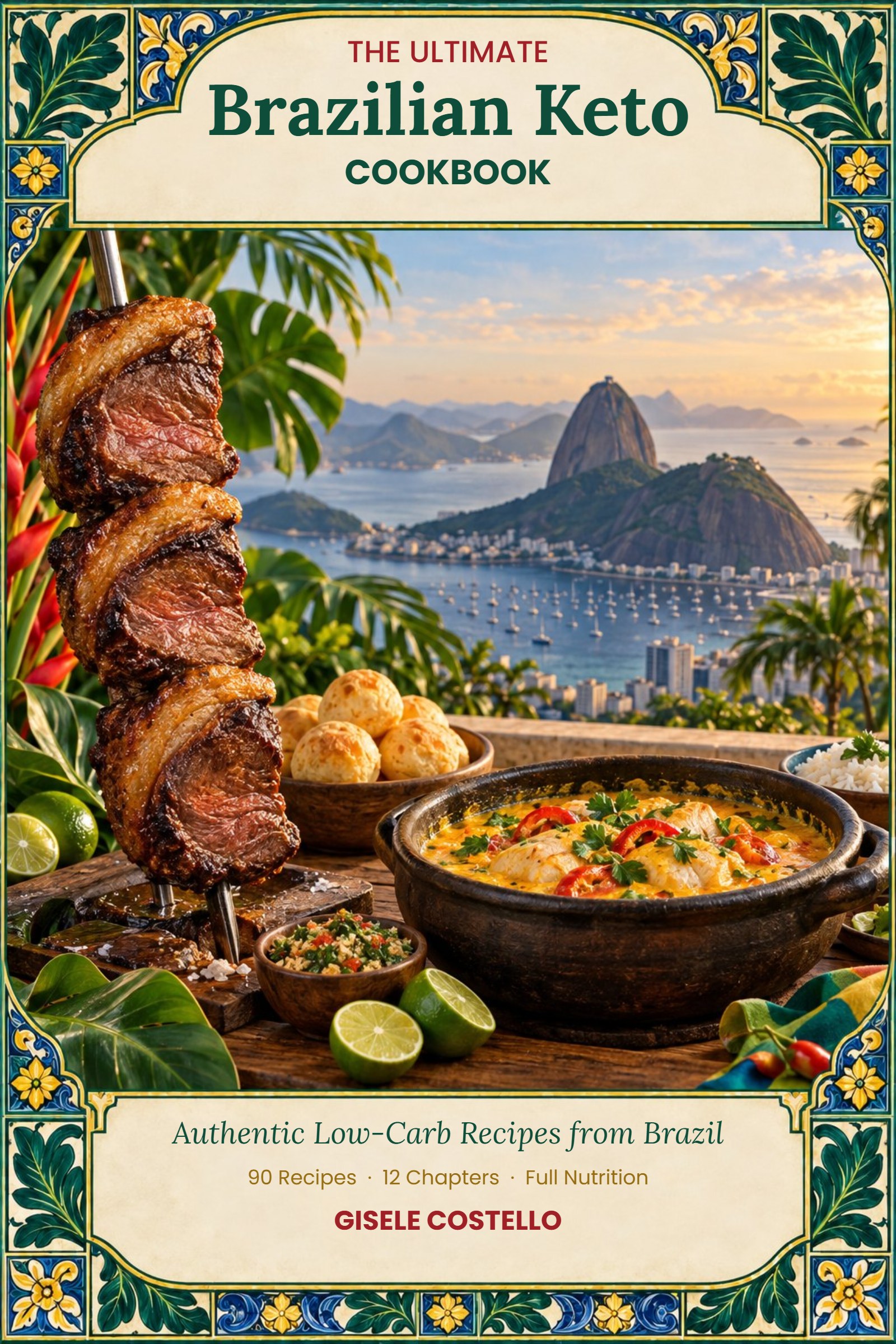
The Ultimate Brazilian Keto Cookbook
Table of Contents · 90 recipes in 12 chapters · by Gisele Costello
Welcome to Brazil: The Meeting of the Waters
Just outside the Amazon city of Manaus, two great rivers come together and refuse to blend. The Rio Negro, dark as strong coffee, meets the sandy, café-au-lait Solimões, and for several miles the two flow side by side in the same channel, a sharp line running down the middle of the water. The rivers differ in temperature, speed and the amount of sediment they carry, so they keep to themselves long after they meet. Only far downstream do they finally mix into the single river the world knows as the Amazon.
Keep reading about Welcome to Brazil: The Meeting of the Waters
Boats leave Manaus every day so visitors can trail a hand in both waters at once and feel the warm Negro give way to the cooler Solimões. Brazil protected the site as part of its national heritage in 2010. It is a fitting place to begin a journey through Brazilian food, because the country’s cooking is itself a meeting of waters: Indigenous ingredients and techniques, Portuguese traditions, the deep influence of Africa, and later waves of Italian, German, Arab and Japanese immigrants, all flowing together yet still recognizable in every region.
Each chapter of this book begins at one of Brazil’s great landmarks. Scroll down and travel the country one region, and one plate, at a time.
Chapter 1: Breakfast · Mercado Municipal
Mercado Municipal
São Paulo’s Mercado Municipal, known to locals simply as the Mercadão, or big market, stands near the Tamanduateí River in the old center of the city. The building was designed in the office of architect Francisco de Paula Ramos de Azevedo, construction began in 1928, and it opened on January 25, 1933, the anniversary of the city’s founding. Before it ever sold a single mango, it served as a depot for weapons and ammunition for São Paulo’s troops during the Constitutionalist Revolution of 1932. Look up when you walk in: 72 stained glass pieces made by the studio of Conrado Sorgenicht Filho fill the windows with scenes of farming, cattle ranching and the harvest.
Keep reading about Mercado Municipal
Today the Mercadão holds more than 290 stalls piled with tropical fruit, cheeses from Minas Gerais, cured meats, spices, salt cod and coffee. Visitors line up for its towering mortadella sandwich and its salt cod pastel, but the market is also a living picture of how Paulistanos start their day: with butter, cheese, eggs, good coffee and fruit blended into creamy vitaminas. This chapter takes the flavors of that market and the corner padaria, the neighborhood bakery where São Paulo eats breakfast standing at the counter, and rebuilds them for a keto kitchen.
Recipes in this chapter
- Brazilian Pão na Chapa, Griddled Buttered Bread Rolls
- Brazilian Misto Quente, Hot Ham and Cheese
- Brazilian Tapioca de Queijo Coalho, Keto Tapioca Crepe with Grilling Cheese
- Brazilian Cuscuz Nordestino, Northeastern Brazilian Steamed Cuscuz
- Brazilian Ovos Mexidos com Requeijão, Creamy Scrambled Eggs with Requeijão
- Brazilian Mingau de Coco, Warm Coconut Breakfast Porridge
- Brazilian Vitamina de Abacate, Avocado Smoothie
Chapter 2: Snacks & Street Food · Historic Ouro Preto
Historic Ouro Preto
Ouro Preto, whose name means black gold, sits among steep green hills in Minas Gerais. It grew out of the gold rush that swept the region at the end of the 1600s, was made a town under the name Vila Rica in 1711, and served as the capital of Minas Gerais until the government moved to the new city of Belo Horizonte in 1897. The name Ouro Preto, adopted in 1823, refers to the dark coating of iron oxide on the gold found in its streams. Its cobbled streets climb past baroque churches covered in gold leaf and carved by the sculptor Aleijadinho, and it was here that the Inconfidência Mineira, a failed independence plot of 1789 led by Tiradentes, was hatched. In 1980 Ouro Preto became the first place in Brazil named a UNESCO World Heritage Site.
Keep reading about Historic Ouro Preto
The gold rush also shaped the food. Miners, farmers and enslaved workers needed meals that were cheap, filling and made from what the farms of Minas produced: pork, cassava, corn and cheese. Those humble ingredients became pão de queijo, crackling torresmo and the snacks still sold today in the town’s botecos, the small neighborhood bars where friends gather over a cold drink and a plate of petiscos. In 2024 the traditional ways of making artisanal Minas cheese were recognized by UNESCO as intangible cultural heritage. This chapter gathers Brazil’s favorite salgados, the savory bites found in every bakery, snack bar and birthday party, and rebuilds them for keto.
Recipes in this chapter
- Brazilian Pão de Queijo, Cheese Bread
- Brazilian Coxinha, Chicken Croquettes
- Brazilian Pastel de Carne, Fried Beef Pastry
- Brazilian Empadinha de Frango, Mini Chicken Pies
- Brazilian Bolinho de Bacalhau, Salt Cod Fritters
- Brazilian Torresmo, Crispy Pork Belly Cracklings
- Brazilian Quibe Assado, Baked Brazilian Kibbeh
- Brazilian Queijo Coalho na Brasa, Grilled Brazilian Cheese Skewers
Chapter 3: Soups & Stews · Ver-o-Peso Market
Ver-o-Peso Market
Ver-o-Peso sprawls along the waterfront of Belém, the capital of Pará, where the Amazon’s rivers meet the Atlantic. Its name means check the weight, and it dates to the 1620s, when the Portuguese set up a post here called the Casa de Haver-o-Peso to weigh goods arriving by boat and collect taxes on them. The market’s best-known building, the Iron Market with its pointed turrets, opened as a fish market in 1901, built around a metal structure brought in from abroad. Brazil’s national heritage institute, IPHAN, listed the market complex in 1977, and it covers about 35,000 square meters of stalls, docks and open-air fairs.
Keep reading about Ver-o-Peso Market
Arrive before dawn and you will see boats unloading river fish and baskets of açaí berries from the islands, while stalls sell bottles of yellow tucupi, bundles of numbing jambu leaves, Amazonian herbs and fiery pimenta de cheiro peppers. Those ingredients are the soul of Pará’s famous soups, such as tacacá, served steaming in gourd bowls, and pato no tucupi, the duck stew at the center of Belém’s great October festival, the Círio de Nazaré. This chapter starts in Belém and travels across Brazil, gathering the broths, soups and stews that Brazilians turn to in cool weather, after a long night, or whenever someone needs comfort.
Recipes in this chapter
- Brazilian Caldo Verde, Collard Green and Sausage Soup
- Brazilian Canja de Galinha, Chicken and Rice Soup
- Brazilian Tacacá, Amazonian Tucupi Broth with Shrimp and Jambu
- Brazilian Pato no Tucupi, Duck in Tucupi Broth with Jambu
- Brazilian Caldeirada de Peixe, Amazonian Fish Stew
- Brazilian Creme de Abóbora com Carne Seca, Creamy Pumpkin Soup with Shredded Dried Beef
- Brazilian Vaca Atolada, Minas-Style Beef Rib Stew
- Brazilian Sopa Leão Veloso, Rio de Janeiro Seafood Soup
Chapter 4: Churrasco & Beef · Ruins of São Miguel das Missões
Ruins of São Miguel das Missões
In the rolling grasslands of northwestern Rio Grande do Sul stand the red sandstone walls of São Miguel Arcanjo, once one of the largest Jesuit missions in South America. The mission was first founded in 1632, destroyed by raiders from São Paulo a few years later, and rebuilt in 1687. Thousands of Guaraní people lived here, farming, carving statues and making music under the direction of the Jesuit fathers. The great church, credited to the Italian Jesuit architect Giovanni Battista Primoli, was built between 1735 and 1750. Today its roofless facade and bell tower are part of the UNESCO World Heritage site of the Jesuit Missions of the Guaranis, inscribed in 1983, and the nearby Missions Museum holds the largest collection of mission-era religious statues in Brazil.
Keep reading about Ruins of São Miguel das Missões
The missions did not live on prayer alone. São Miguel ran a vast cattle ranch, or estância, and was one of the major cattle-breeding centers of the region. Herds raised by the missions, and the cattle that wandered free across the southern pampas, became the foundation of the gaúcho way of life. Cowboys on the open range cooked their beef the simplest way possible: big cuts on a stick, coarse salt, and a slow fire. That is churrasco, and it is still the pride of Rio Grande do Sul. This chapter brings the grill, the skewer and the cast-iron pan into your kitchen, from salt-crusted picanha to the beloved beef dishes of Rio, São Paulo and the Northeast.
Recipes in this chapter
- Brazilian Picanha na Brasa, Salt-Crusted Grilled Picanha
- Brazilian Fraldinha Marinada, Garlic and Lime Marinated Flap Steak
- Brazilian Costela Assada, Slow-Roasted Beef Ribs
- Brazilian Espetinho de Alcatra, Top Sirloin Skewers
- Brazilian Bife à Cavalo, Steak with a Fried Egg on Horseback
- Brazilian Carne de Sol com Manteiga de Garrafa, Northeastern Salted Beef with Clarified Butter
- Brazilian Picadinho Carioca, Rio-Style Diced Beef Stew
- Brazilian Escondidinho de Carne Seca, Hidden Dried Beef and Cauliflower Casserole
- Brazilian Carne Louca, São Paulo Party Shredded Beef
Chapter 5: Chicken · Cathedral of Brasília
Cathedral of Brasília
Rising from the open plain of Brazil’s capital, the Metropolitan Cathedral of Our Lady of Aparecida looks like a crown, or a pair of hands reaching up to the sky. Architect Oscar Niemeyer designed it as a ring of 16 curved concrete columns, each weighing about 90 tonnes, joined at the top and filled with glass. The cornerstone was laid in 1958, the concrete structure was finished in 1960 as the new capital was inaugurated, and the cathedral was officially opened in 1970. Inside, bronze angels by sculptor Alfredo Ceschiatti hang from the ceiling, four tall bronze evangelists guard the entrance, and since 1990 sweeping stained glass by Marianne Peretti has bathed the nave in blue, green and white light. Visitors enter through a dark, low passage and then step up into that bright space, which is exactly the effect Niemeyer intended.
Keep reading about Cathedral of Brasília
Brasília was built from scratch in the late 1950s in the dry cerrado highlands, in a district carved out of the state of Goiás. Tens of thousands of workers, nicknamed candangos, came from every corner of the country, especially the Northeast, Minas Gerais and Goiás, and they brought their family recipes with them. Chicken was the dish almost every one of them knew how to cook: galinhada from Goiás, frango com quiabo from Minas, xinxim from Bahia. This chapter gathers those regional chicken favorites, from Sunday roast chicken to creamy strogonoff, in a city that has always been a meeting place for all of Brazil.
Recipes in this chapter
- Brazilian Galinhada, Goiás-Style Golden Chicken and Rice
- Brazilian Frango com Quiabo, Minas Gerais Chicken with Okra
- Brazilian Frango Assado, Garlic and Lime Roast Chicken
- Brazilian Frango à Passarinho, Crispy Garlic Chicken Bites
- Brazilian Coração de Frango no Espeto, Grilled Chicken Heart Skewers
- Brazilian Fricassê de Frango, Creamy Baked Chicken Fricassee
- Brazilian Strogonoff de Frango, Chicken Stroganoff
- Brazilian Xinxim de Galinha, Bahian Chicken with Peanuts, Cashews and Dendê
Chapter 6: Pork · Historic Paraty
Historic Paraty
Paraty sits on a quiet bay between green mountains and the sea, its whitewashed houses trimmed in bright blue, yellow and green, its streets paved with big, uneven stones. Founded in the 1500s and established as a town in the 1660s, it became one of the most important ports in colonial Brazil after gold was discovered in Minas Gerais in the 1690s. Gold traveled down the Caminho do Ouro, the Gold Trail, a stone-paved route over the mountains, and left Paraty by ship for Rio de Janeiro and then Portugal. When safer routes were opened and the gold ran out in the late 1700s, Paraty slowly slipped into isolation, which is exactly why its colonial center survives almost untouched. In 2019, Paraty and nearby Ilha Grande were named a UNESCO World Heritage Site for both their culture and their biodiversity. At the highest tides, seawater still flows gently into the old streets, washing over the cobblestones as it has for centuries.
Keep reading about Historic Paraty
The same mountain trails that carried gold down to the coast carried food up into the interior. Tropeiros, the mule drivers who led pack trains along these routes for weeks at a time, lived on food that would keep: salted and smoked pork, sausages, beans and toasted flour. Their trail cooking gave Brazil feijão tropeiro, and the farms of the interior learned to preserve pork in its own fat. Paraty itself turned to cachaça, the sugarcane spirit its stills still produce today. This chapter celebrates the pork dishes that grew from those roads, from the great feijoada to crackling pururuca.
Recipes in this chapter
- Brazilian Feijoada, Black Bean and Pork Stew, Keto Style
- Brazilian Lombo Assado, Garlic and Wine Roast Pork Loin
- Brazilian Pernil Assado, Slow-Roasted Brazilian Pork Shoulder
- Brazilian Costelinha de Porco Assada, Garlic and Lime Baked Pork Ribs
- Brazilian Porco à Pururuca, Crackling-Skin Roast Pork Belly
- Brazilian Feijão Tropeiro, Mule Drivers’ Beans with Bacon, Sausage and Greens
- Brazilian Carne de Porco na Lata, Pork Preserved in Its Own Fat
Chapter 7: Seafood · Pelourinho
Pelourinho
Pelourinho is the heart of the Historic Centre of Salvador, perched on the cliff of the upper city above the Bay of All Saints. Salvador was founded in 1549 and served as the capital of colonial Brazil until 1763, when the seat of government moved to Rio de Janeiro. Its steep cobblestone streets are lined with pastel townhouses and baroque churches built from the 17th to the 19th centuries, and UNESCO named the Historic Centre a World Heritage Site in 1985. The name itself carries a painful memory: pelourinho means “pillory,” after the whipping post that once stood in the main square, where enslaved Africans were publicly punished.
Keep reading about Pelourinho
Salvador was one of the great ports of the Atlantic slave trade, and the African men and women brought to Bahia shaped its kitchen more than any other influence. Dendê oil from the African oil palm, okra, dried shrimp, ginger and fresh chilies meet Indigenous and Portuguese techniques in dishes like moqueca, vatapá, caruru and bobó. Many of these foods are also sacred offerings in Candomblé, the Afro-Brazilian religion that is deeply rooted in Bahia. Walk through Pelourinho today and you will hear drum groups rehearsing, smell dendê sizzling, and see baianas de acarajé in white lace skirts and turbans, whose craft was registered as part of Brazil’s cultural heritage in 2005. This chapter brings that coastal, coconut-and-dendê cooking to your table, with the starchy sides swapped for keto-friendly ones.
Recipes in this chapter
- Brazilian Moqueca Baiana, Bahian Fish Stew with Coconut Milk and Dendê
- Brazilian Moqueca Capixaba, Espírito Santo Fish Stew with Tomato and Annatto
- Brazilian Bobó de Camarão, Creamy Bahian Shrimp in Coconut Purée
- Brazilian Vatapá, Bahian Shrimp, Coconut and Nut Cream
- Brazilian Caruru, Bahian Okra Stew with Dried Shrimp
- Brazilian Casquinha de Siri, Baked Crab in the Shell
- Brazilian Camarão ao Alho e Óleo, Garlic and Olive Oil Shrimp
- Brazilian Bacalhoada, Baked Salt Cod with Olive Oil, Peppers and Eggs
- Brazilian Peixada Cearense, Ceará-Style Fish and Vegetable Pot
Chapter 8: Vegetables & Sides · Iguaçu Falls
Iguaçu Falls
On Paraná’s western edge, where Brazil meets Argentina, the Iguaçu River spills over a long, horseshoe-shaped series of cliffs in somewhere between 150 and 300 separate waterfalls, depending on how much rain has fallen upstream. The largest, a deep U-shaped chasm called the Garganta do Diabo, or Devil’s Throat, sends up a cloud of mist that can be seen long before the falls themselves. The name Iguaçu is usually translated from the Guarani language as “great water.” Brazil created Iguaçu National Park in 1939 to protect the falls and the subtropical Atlantic Forest around them, and UNESCO declared it a World Heritage Site in 1986.
Keep reading about Iguaçu Falls
The land that feeds the falls also feeds Brazil. Paraná’s deep red soil makes it one of the country’s great farming states, and waves of Polish, Ukrainian, German, Italian and Japanese immigrants brought their vegetable gardens with them. For centuries the state was also crossed by tropeiros, mule drivers who herded animals north from Rio Grande do Sul through Paraná’s highland plains to the market at Sorocaba in São Paulo. They lived on beans, manioc flour, salt pork and greens cooked over campfires, and their trail food became feijão tropeiro. Paraná’s own beloved staple is pinhão, the seed of the Paraná pine, roasted or boiled every winter, though it is far too starchy for keto. The sides in this chapter are the everyday companions of the Brazilian plate: greens, farofa, “rice,” purées and simple sautéed vegetables, all made low carb.
Recipes in this chapter
- Brazilian Farofa de Ovo e Bacon, Keto Toasted Farofa with Egg and Bacon
- Brazilian Couve à Mineira, Minas-Style Garlicky Collard Greens
- Brazilian Arroz Branco, Brazilian-Style Garlic Cauliflower Rice
- Brazilian Purê de Mandioquinha, Silky Root Purée in the Style of Mandioquinha
- Brazilian Chuchu Refogado, Sautéed Chayote with Tomato and Herbs
- Brazilian Torta de Palmito, Hearts of Palm Pie
- Brazilian Vagem Refogada, Sautéed Green Beans with Garlic and Tomato
- Brazilian Jiló Refogado, Sautéed Bitter Garden Eggplant
Chapter 9: Salads · Lençóis Maranhenses National Park
Lençóis Maranhenses National Park
On the northern coast of Maranhão, white sand dunes roll inland from the Atlantic for miles, looking from the air like sheets spread out to dry. That is exactly what the name means: lençóis are bedsheets. Every year the rainy season, roughly January to June, fills the hollows between the dunes with thousands of clear freshwater lagoons in shades of blue and green, and they slowly shrink and vanish again in the dry months. Some fish even survive the dry season buried in the damp mud and return when the rains come back. Brazil made the area a national park in 1981, protecting about 155,000 hectares, and UNESCO added it to the World Heritage List in 2024.
Keep reading about Lençóis Maranhenses National Park
Most visitors reach the dunes from the town of Barreirinhas on the Preguiças River, then hike over the sand to swim in the warm, rain-filled lagoons. Life on this coast revolves around fishing and the heat, and Maranhão’s cooking leans on shrimp, fresh fish and tangy greens like vinagreira, the leaf that flavors the state’s famous arroz de cuxá. In a climate this hot, a crisp, cool salad is as much a part of the Brazilian table as rice and beans. The salads in this chapter range from everyday plates of chayote and cabbage to the creamy party salads that crowd the table at Christmas, all made keto.
Recipes in this chapter
- Brazilian Salada de Palmito, Hearts of Palm Salad with Tomato and Lime
- Brazilian Salpicão de Frango, Holiday Chicken Salad
- Brazilian Salada de Maionese, Creamy Vegetable and Egg Salad
- Brazilian Tabule, Brazilian-Lebanese Parsley and Cauliflower Salad
- Brazilian Salada de Chuchu, Chilled Chayote Salad with Tomato
- Brazilian Salada de Repolho, Cabbage and Carrot Slaw with Lime
Chapter 10: Sauces & Condiments · Historic Olinda
Historic Olinda
Olinda sits on a green hillside above the Atlantic, just north of Recife, its steep cobbled lanes lined with brightly painted colonial houses and baroque churches. It was founded in 1535 by the Portuguese nobleman Duarte Coelho as the seat of the captaincy of Pernambuco, which grew rich on sugarcane. In 1631, during the Dutch occupation of northeastern Brazil, the town was set on fire, and many of the churches and convents you see today were rebuilt in the years that followed. In 1982 its historic center was declared a UNESCO World Heritage Site.
Keep reading about Historic Olinda
Today Olinda is best known for its Carnival, when the hills fill with frevo and maracatu music and giant papier-mâché puppets, the bonecos gigantes, dance through the streets. The cooking of Pernambuco and the wider Northeast is bold and generous with seasoning: garlic pounded with salt, fiery fresh peppers, golden bottle butter from the dry backlands, and a bowl of vinagrete on every table where meat is grilled. This short chapter gathers those everyday sauces and condiments, naturally low in carbs or easily made so, which you will use throughout the book.
Recipes in this chapter
- Brazilian Molho Vinagrete, Tomato and Pepper Salsa
- Brazilian Molho de Pimenta, Hot Pepper Sauce
- Brazilian Tempero Baiano, Bahian Spice Blend
- Brazilian Alho e Sal, Garlic and Salt Seasoning Paste
- Brazilian Requeijão Cremoso, Homemade Creamy Brazilian Cheese Spread
- Brazilian Manteiga de Garrafa, Northeastern Bottle Butter
Chapter 11: Desserts · Sugarloaf Mountain (Pão de Açúcar)
Sugarloaf Mountain (Pão de Açúcar)
Sugarloaf Mountain rises 396 meters straight out of the water on a peninsula at the mouth of Guanabara Bay. Its name goes back to the 16th century, when Brazil’s sugarcane trade was booming: refined sugar was shaped and shipped in tall conical clay molds, and the Portuguese thought the rounded granite peak looked just like one of those sugar loaves. In 1912 a cable car opened to the summit, proposed by the engineer Augusto Ferreira Ramos, and visitors still ride it in two stages, first to Morro da Urca and then to the top of Sugarloaf.
Keep reading about Sugarloaf Mountain (Pão de Açúcar)
The mountain’s name is a reminder of how deeply sugar shaped Brazil. Sugar plantations built the colony’s wealth, and the country’s sweets grew from Portuguese convent recipes rich in egg yolks, coconut brought by the Portuguese, and later sweetened condensed milk, which became the heart of Brazilian dessert making in the 20th century. This chapter keeps the classics, from brigadeiros and quindim to pudim and passion fruit mousse, and swaps the sugar and condensed milk for allulose and slowly reduced cream.
Recipes in this chapter
- Brazilian Brigadeiro, Chocolate Fudge Truffles
- Brazilian Beijinho, Coconut Kisses
- Brazilian Quindim, Glossy Coconut Egg Yolk Custards
- Brazilian Pudim de Leite, Caramel Flan
- Brazilian Cocada, Chewy Coconut Candy
- Brazilian Mousse de Maracujá, Passion Fruit Mousse
- Brazilian Bolo de Cenoura, Carrot Cake with Chocolate Topping
- Brazilian Creme de Abacate, Sweet Avocado Cream
- Brazilian Pé de Moleque, Peanut Brittle Squares
Chapter 12: Drinks · Copacabana Beach
Copacabana Beach
Copacabana’s long curve of sand runs for about 4 kilometers along Rio de Janeiro’s South Zone, between the Leme hill at one end and Fort Copacabana, built in 1914, at the other. The area was once called Sacopenapã, a Tupi name, and took its present name from a chapel built in the 18th century to hold a replica of Our Lady of Copacabana, the patron saint of Bolivia. When the first tunnels connected it to the rest of the city at the end of the 19th century, the neighborhood boomed, and the grand Copacabana Palace hotel opened on the seafront in 1923. The black and white wave pattern of the promenade is made of Portuguese stone paving, and the landscape architect Roberto Burle Marx redesigned the seafront when the avenue was widened around 1970.
Keep reading about Copacabana Beach
Copacabana is Rio’s great outdoor living room. Every New Year’s Eve, an estimated two million people dressed in white gather on the sand for the fireworks. On ordinary days, vendors walk the beach with metal drums of iced mate and lemonade, calling out to sunbathers, while beach kiosks serve caipirinhas and coconut drinks. This short chapter brings you those flavors, from a strong morning cafezinho to an icy batida, all made without sugar.
Recipes in this chapter